
Income-Based Repayment (IBR) Calculator for Student Loans
Last Updated: August 6, 2025
Not sure whether you qualify for Old IBR or New IBR?
Wondering what your monthly payment might look like?
This page can help.
IBR calculates your student loan payment based on your income and family size.
Your loan balance and interest rate do not affect the monthly payment directly, but they do matter when it comes to the payment cap.
This may come into play for high-earning physicians.
There are two versions of IBR, and which one you qualify for depends on when you first borrowed federal student loans.
👇 Try the IBR Calculator Below
Want to see how New IBR compares to Old IBR?
Enter your info to estimate your monthly payment under each plan.
IBR Student Loan Calculator
Your Monthly Payments
| New IBR | Old IBR |
|---|---|
| $0 | $0 |
Please enter valid info to estimate your payments
Married? Or want to see how IBR compares to PAYE and RAP?
Check out the full IDR Calculator instead.
Calculations are believed to be correct. If you notice anything that doesn’t look right, please send an email to michael@dreambiggerfinancial.com.
So… How Does IBR Actually Work?
Let’s start with the basics.
Most people assume their student loan payment is based on how much they owe.
That’s true under the 10-Year Standard Repayment Plan, which is the default if you don’t take action after graduation.
But IBR works differently.
It’s based on:
-
-
Your income (the higher your income, the higher your payment)
-
Your family size (the bigger your family, the lower your payment)
-
It’s designed to adjust with your life.
Lower payments when you are just getting started. Higher payments as your income grows.
Let’s take Dr. Patel as an example.
He’s a first-year resident earning $60,000. He has $300,000 in student loans.
-
- Under New IBR, his monthly payment is around $300.
- Under Old IBR, it’s closer to $450.
That’s manageable, especially during training.
But once he becomes an attending making $300,000, both IBR plans recalculate based on that new income.
His payment goes up… and that shift can catch people off guard if they’re not planning for it.
Understanding how IBR works now can help you stay ahead of those future jumps.
IBR – Plan Overview
There are two versions of Income-Based Repayment, depending on when you first borrowed federal student loans.
Here’s a quick look at how each one works:
New IBR
For borrowers who took out loans on or after July 1, 2014
-
-
10% of your discretionary income
-
Forgiveness after 20 years of qualifying payments
-
Includes poverty line deduction of 150%
-
Monthly payment can be capped at the 10-Year Standard Repayment Plan amount
-
Spouse’s income can be excluded if you file taxes separately
-
No interest subsidy
-
Old IBR
For borrowers who took out loans before July 1, 2014
-
-
15% of your discretionary income
-
Forgiveness after 25 years of qualifying payments
-
Includes poverty line deduction of 150%
-
Monthly payment can be capped at the 10-Year Standard Repayment Plan amount
-
Spouse’s income can be excluded if you file taxes separately
-
No interest subsidy
-
👇 Use The IDR Plan Finder to Check What Plan You Are Eligible For
Not sure which repayment plans you qualify for?
You’re not alone. The rules can feel confusing, and eligibility isn’t always clear.
Answer a few quick questions and this tool will narrow down which Income-Driven Repayment plans you may qualify for so you know what’s available to you.
Ready?
Who Can Still Use IBR?
The One Big Beautiful Bill, passed on July 4, 2025, brought some big changes to student loan repayment.
Starting July 1, 2026, not everyone will be able to enroll in IBR anymore.
It all depends on whether you’re considered a new borrower or an old borrower.
So… which one are you?
-
-
New borrowers are anyone who takes out a federal student loan on or after July 1, 2026
-
Old borrowers are those who took out all of their loans before July 1, 2026 and don’t borrow again after that date
-
This cutoff matters because your repayment plan options depend on which group you’re in.
If you’re a new borrower…
Your income-based repayment options will be limited to:
-
-
The New Standard Plan, which is based on how much you owe and your interest rate
-
The new RAP Plan, which is based on your Adjusted Gross Income (AGI) and number of kids under 17
-
You won’t be eligible for IBR or PAYE.
If you’re an old borrower…
You’ll still be able to access:
-
-
PAYE, until it’s phased out in July 2028
-
IBR, with no current end date
-
RAP, once it launches in 2026
-
Old Standard Repayment Plan
-
Graduated Repayment Plan
-
Extended Repayment Plan
-
If you’re already on IBR before July 2026, you can stay on it as long as you want.
Even if you’re not on IBR now, you can still enroll in it later as long as you’re an old borrower and meet the eligibility rules.
But PAYE is going away… Even if you’re using PAYE now, you’ll eventually have to switch to IBR or RAP.
One thing to know about switching plans:
Old borrowers who choose RAP can technically switch to IBR later, but any time spent in RAP won’t count toward forgiveness under IBR.
Your forgiveness clock under RAP continues while you’re in that plan, but if you move back to IBR, it starts fresh for that plan.
So you can’t spend 5 years in RAP, then switch to IBR and expect those 5 years to count. They won’t.
Choose your plan carefully based on your goals.
Need help deciding?
Reach out for a custom plan.
What If My Income Is Too High?
Before the One Big Beautiful Bill passed, you could only enroll in IBR if you had what’s called a partial financial hardship.
That meant your income had to be low enough that your IBR payment would be less than your 10-Year Standard Plan payment, which is based on your loan balance and interest rate.
This rule blocked many new attendings with higher incomes from using IBR.
But that is no longer the case.
As of July 4, 2025, the partial financial hardship requirement has been removed for old borrowers.
If you took out all of your loans before July 1, 2026 and do not borrow again after that date, you are considered an old borrower and you can enroll in IBR regardless of your income.
Important note:
The Department of Education still needs to update its online IDR application to reflect this change. If you apply too soon, the system may incorrectly prevent you from selecting IBR based on the old income rules. This should be fixed within a few months of the bill’s passing.
Bottom line:
If you are an old borrower, you will eventually be able to choose IBR even if your income is high. You might just need to wait for the system to catch up.
IBR – Poverty Line Deduction
Think of this like the standard deduction on your tax return.
Before your student loan payment is calculated, the government gives you a poverty line deduction to make sure you have enough to cover basic living expenses.
Here’s how it works:
-
-
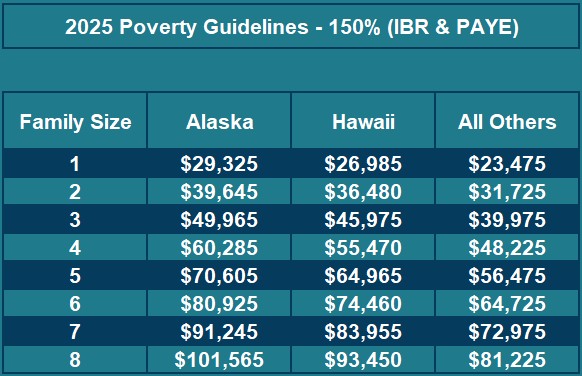
The Department of Education uses the federal poverty guidelines based on your family size and location (see table below).
-
Then they multiply that number by 150 percent.
-
That amount gets subtracted from your Adjusted Gross Income (AGI).
-
The rest is considered discretionary income, which is used to calculate your monthly IBR payment.
-
In simple terms:
Bigger family = higher deduction = lower monthly payment.
This poverty line buffer is built in to keep your payment realistic, especially early in your career.
IBR – Payment and Forgiveness Timeline
The Income-Based Repayment (IBR) plan bases your monthly payment on a percentage of your discretionary income:
-
-
New IBR applies if you took out federal loans on or after July 1, 2014. You pay 10 percent of your discretionary income for 20 years. After that, any remaining balance is forgiven. That forgiveness may be taxable.
-
Old IBR applies if you borrowed before July 1, 2014. You pay 15 percent of your discretionary income for 25 years. Any remaining balance is also forgiven and may be treated as taxable income.
-
Now here is what really matters for most physicians:
If you work for a nonprofit hospital or another qualifying 501(c)(3) employer, you may be eligible for Public Service Loan Forgiveness (PSLF).
With PSLF, your remaining balance is forgiven after 10 years of qualifying payments. This forgiveness is completely tax free.
Most physicians will not stay on IBR long enough to reach the 20 or 25 year forgiveness mark.
But PSLF offers a much shorter path and a better long-term result.
If you are pursuing PSLF, the goal is not to finish the full 20 year/25 year repayment term.
The goal is to get as much forgiven as possible in year 10, using a qualifying plan like IBR along the way.
IBR – Payment Cap
One unique feature of IBR is the payment cap.
This puts a ceiling on how much your monthly student loan payment can be.
Your payment will never be higher than what you would pay on the 10-Year Standard Repayment Plan, even if your income goes way up.
That can be a big deal for physicians whose income rises sharply after training.
Let’s say you have $250,000 in student loans at 6% interest.
The 10-Year Standard payment would be about $2,776 per month.
Under IBR, that’s the highest your payment could ever be, even if your income suggests you should be paying more.
This cap helps protect high earners from seeing their payments grow indefinitely.
RAP does not offer this. There is no cap. The higher your AGI, the higher your RAP payment could go.
If you expect your income to increase significantly, especially after training, this feature of IBR may become very important.
Use the calculator below to enter your student loan balance and average interest rate.
You’ll see how the IBR payment cap compares to your income-driven payment based on your income and family size.
This is a great way to understand how much the cap might matter, especially as your income grows over time.
New IBR Monthly Payment Grid
Old IBR Monthly Payment Grid
IBR –
This is one of the biggest benefits of IBR for married borrowers.
If you file your taxes as Married Filing Separately (MFS), your spouse’s income can often be excluded from the student loan payment calculation.
This strategy can make a big difference, especially if your partner earns significantly more than you. For physicians in training, it is often the key to keeping payments low.
But here is the thing… this is not a simple yes or no decision.
Filing separately might reduce your student loan payment, but it can also increase your tax bill. The tradeoff depends on your income, your state, your family situation, and your goals.
What About Dr. Patel?
Let’s look at two scenarios.
Dr. Patel lives in North Carolina, a non-community property state. He is a resident earning $60,000 and is married to a partner earning $300,000 as an attending.
If they file jointly, his student loan payment is based on both incomes.
But if they file separately, only his income is used to calculate the payment. That can drop his monthly payment by over two thousand dollars depending on the plan.
Now imagine Dr. Patel lives in California, a community property state.
He and his spouse still file separately, but under community property rules, their adjusted gross income (AGI) is automatically split 50-50 between them for tax purposes.
That means his student loan payment will be based on half of their combined income… even though they filed taxes separately.
In this case, their household income is $360,000. That gets split evenly, so Dr. Patel’s payment will be based on $180,000.
It is still a big improvement compared to using the full household income, but not as low as it would be in a non-community property state.
This is one of the most powerful planning strategies for married physicians, but also one of the most misunderstood.
It is a legitimate way to reduce payments, but the rules are complex and often misapplied. And because your income and family situation change year to year, the strategy needs to be reviewed regularly.
If you are not sure whether to file jointly or separately, or how your state affects the math, this guide can help!
Or feel free to reach out for one-on-one help.
A Quick Note on Community Property States
If you live in one of these 9 states, community property laws apply when you file taxes separately:
-
-
Arizona
-
California
-
Idaho
-
Louisiana
-
Nevada
-
New Mexico
-
Texas
-
Washington
-
Wisconsin
-
These rules affect how income is reported on your tax return, and by extension, how your student loan payment is calculated under IBR and other IDR plans.
This type of tax planning and student loan strategy is one of the biggest reasons physicians come to us. We help you look at the full picture so you can make a smart, informed decision that works for your life… not just your loans.
IBR –
One thing to keep in mind with IBR: if your monthly payment doesn’t cover all the interest that accrues, the leftover interest gets added to your balance.
This means your loan balance can grow over time… especially during training when your income (and payment) is lower.
This is called negative amortization.
Let’s say your loan accrues $1,000 of interest each month, but your IBR payment is $300. That $700 difference doesn’t go away, it builds onto your loan balance.
If you’re going for Public Service Loan Forgiveness (PSLF), this isn’t something to stress over.
Your full remaining balance is forgiven after 120 qualifying payments, no matter how big it gets.
But if you’re not going for PSLF, balance growth can lead to a higher total cost over time.
Quick Comparison to RAP
The RAP plan works differently. Using the same example above, if your RAP payment is $300 and the interest is $1,000… your balance stays flat.
It won’t grow from unpaid interest.
Note: That’s not exactly how RAP’s interest formula works, but for simplicity, just know that your balance won’t grow significantly on RAP.
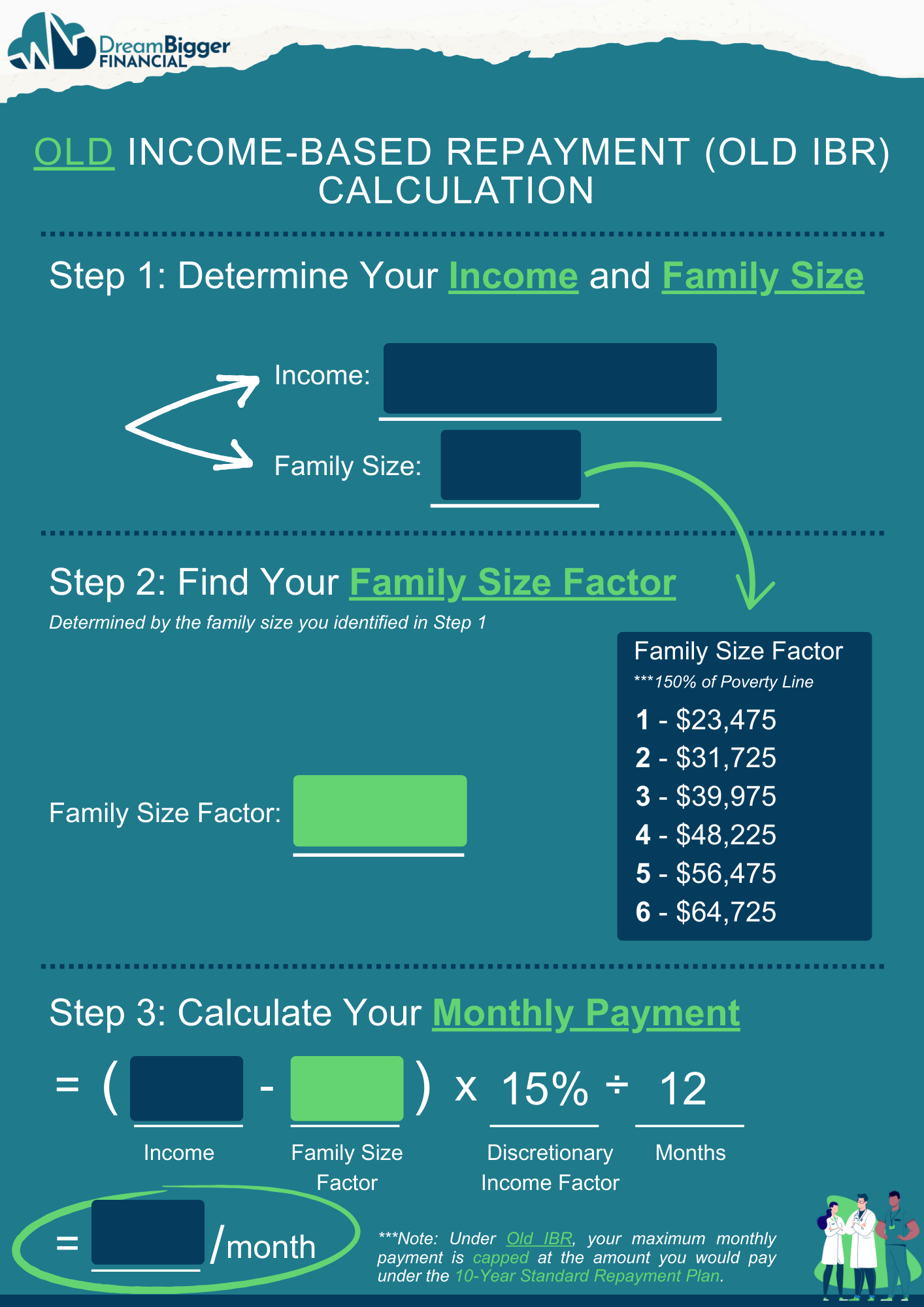
How Your Old IBR Payment Is Calculated
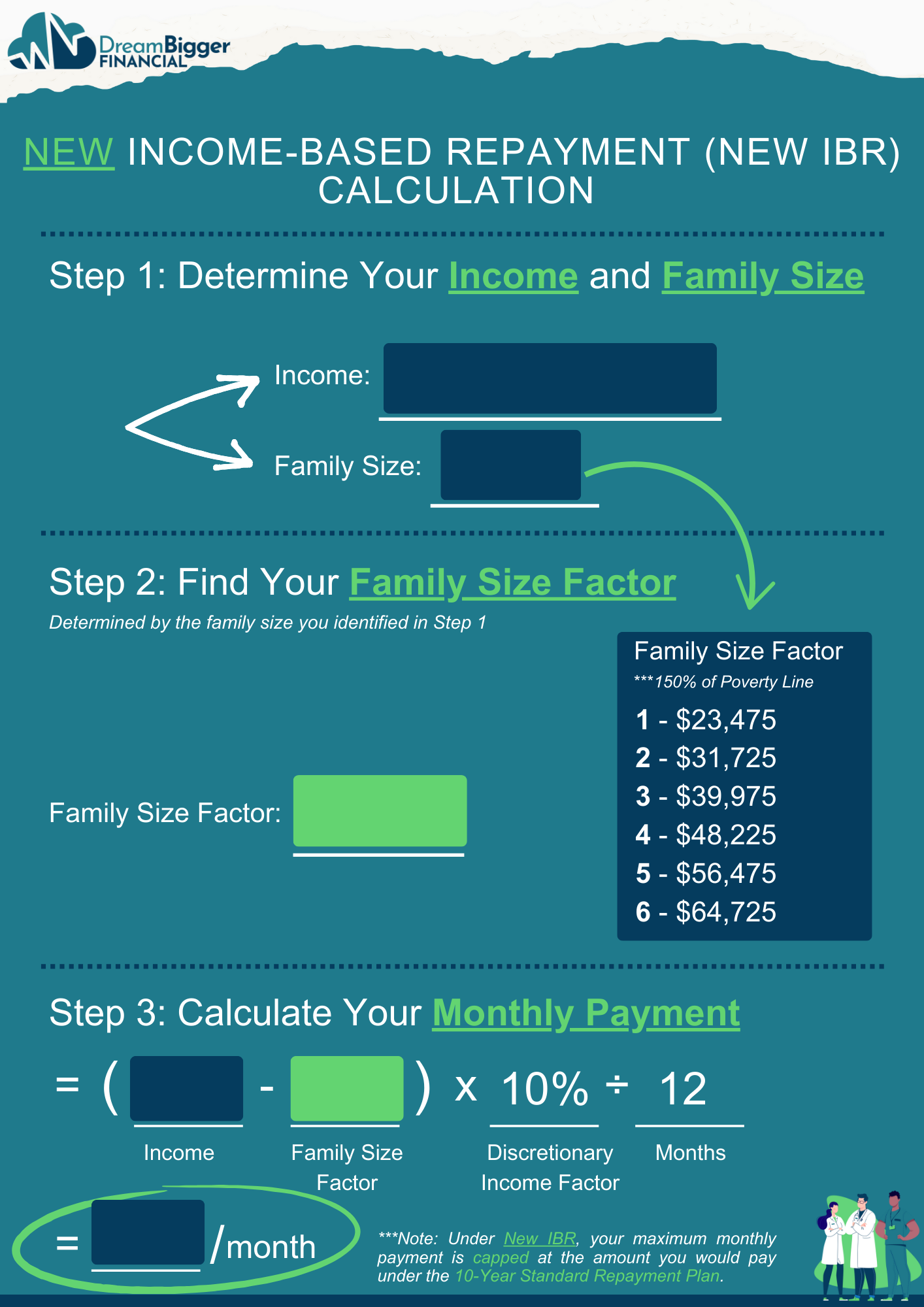
How Your New IBR Payment Is Calculated
IBR –
On an Income-Driven Repayment (IDR) plan like IBR, your monthly student loan payment is based on your income and family size.
In general:
-
-
Higher income = higher payment
-
Lower income = lower payment
-
There are two main ways your income can be calculated for an IDR plan:
Option 1: Use Your Tax Return (Adjusted Gross Income)
The most common method is to use your Adjusted Gross Income (AGI) from your prior year’s tax return. You’ll find this number on Line 11 of IRS Form 1040.
AGI includes things like:
-
-
Wages and self-employment income
-
Dividends and interest
-
Other sources of taxable income
-
Minus certain deductions like pre-tax retirement contributions and HSA contributions.
If you’re married, your household income may be included depending on how you file your taxes.
Filing separately can sometimes lower your student loan payment, but it’s not always the best move.
As mentioned earlier, the pros and cons depend on your income, your partner’s income, and which state you live in.
Option 2: Use Paystubs (Alternative Documentation of Income)
If you haven’t filed a tax return yet or your income has recently dropped, you can use your paystubs instead.
This is called Alternative Documentation of Income.
Let’s say Dr. Patel just started residency and hasn’t filed a tax return yet.
He earns $60,000 per year as a new intern.
Since he doesn’t have a tax return on file, he’ll need to submit a recent paystub when applying for IBR.
The loan servicer will then use that paystub to estimate his annual income and calculate his monthly student loan payment.
IBR –
Your monthly student loan payment under an Income-Driven Repayment (IDR) plan is based on two things:
-
-
Higher income = higher payment
-
Larger family = lower payment
-
So how do you figure out your family size?
It includes:
-
-
You
-
Your spouse
-
Any children or other dependents who get more than half of their support from you
-
Any unborn children (yep, they count too)
-
Your family size helps determine your poverty line deduction, which lowers the portion of your income used to calculate your student loan payment.
New IBR Monthly Payment Example
Dr. Patel’s Situation
-
-
Loan Balance: $250,000
-
Interest Rate: 6.0%
-
Income: $60,000 (first-year resident)
-
Family Size: 1
-
Plan Type: New IBR (for loans taken out on or after July 1, 2014)
-
Under the 10-Year Standard Repayment Plan (the default option), Dr. Patel’s monthly payment would be $2,776 based on his loan balance and interest rate.
But as a new resident earning $60,000, that payment would be way too high.
So he looks into New IBR instead.
Under New IBR, his payment drops to just $304 per month, which saves him over $2,400 each month compared to the standard plan.
That lower payment gives him the flexibility he needs during training.
One thing to keep in mind: since his New IBR payment may not fully cover the interest, his loan balance could grow over time. But if he is working toward PSLF, that will not matter because the full balance would be forgiven after 10 years of qualifying payments.
What if Dr. Patel had loans from before July 1, 2014?
He would be on Old IBR, which uses 15 percent of discretionary income.
In that case, his monthly payment would be around $457 instead of $304.

Common Questions
Eligibility & Plan Access
What’s happening to repayment plans in the future?
The student loan system is changing. With new rules and new plans coming, it’s important to understand whether you’re considered a new borrower or an old borrower:
-
-
New borrowers: Anyone who takes out a federal student loan on or after July 1, 2026
-
Old borrowers: Anyone who took out all of their loans before July 1, 2026 and doesn’t borrow again after that date
-
What plans are available to new borrowers?
If you’re a new borrower, your options will be:
-
-
The Standard Plan, based on your loan balance and interest rate
-
The new RAP Plan, based on AGI and number of kids under 17
-
PAYE and IBR will no longer be available for new borrowers starting July 1, 2026.
What if I’m an old borrower?
If you don’t take out any new loans after July 1, 2026, you’ll still have access to PAYE, IBR, and the new RAP plan.
Both PAYE and IBR will be closed to new borrowers starting July 1, 2026. PAYE will also be phased out entirely by July 2028 for existing borrowers, unless they switch to IBR or RAP.
If you’re on IBR before that deadline, you can stay on it. But you won’t be able to stay on PAYE.
Plan Mechanics
Does IDR work for PSLF?
Yes. RAP, IBR, and PAYE are all eligible repayment plans for Public Service Loan Forgiveness (PSLF). If you work for a nonprofit hospital, university, or health system, this is likely the route you want to be on.
Which IDR plan should I pick?
It depends on your income, loan type, family situation, and long-term goals. The calculator above is a great starting point.
But if you want to get it right and avoid costly mistakes, let’s talk. We can build a custom game plan together.
If I’m married, does my partner’s income affect my payment?
Yes. If you file taxes jointly, your partner’s AGI is included in the income calculation.
For PAYE and IBR, your partner is also part of your family size.
Some physicians choose to file taxes separately to exclude their partner’s income.
That can lower your student loan payment… but it may increase your tax bill.
Not a decision to make lightly.
If you’re in this boat, let’s talk it through.
RAP vs IBR – What’s the Difference
What’s so great about RAP?
RAP includes one major benefit: no negative amortization.
If your payment doesn’t fully cover your monthly interest, your loan balance won’t grow.
Let’s say you owe $250,000 at 6% interest. Your 10-Year Standard payment is $2,776, but as a resident earning $60,000, your RAP payment might only be $250. Under PAYE or IBR, the difference would be added to your balance. Under RAP, your balance stays flat.
Important: If you’re pursuing PSLF, it doesn’t matter how big your loan balance gets… it’ll be forgiven tax-free after 120 payments. So don’t pick RAP just to avoid balance growth if PSLF is your goal.
But if you’re not going for PSLF?
RAP can be a great fit during training. It keeps your low without ballooning your balance — giving you less to pay off once you’re making attending income.
Sounds great. What’s the catch?
RAP doesn’t have a payment cap.
IBR and PAYE both cap your payment at the Standard Plan amount (around $2,776/month).
But RAP has no ceiling… if your income goes up, your payment can too.
Example:
If your income rises to $600,000, your RAP payment might exceed $5,000/month.
That could make RAP more expensive long-term, especially for high earners after training.
Want Help Double Checking Your Plan?
Most people can get pretty far on their own using this guide and the IDR Plan Finder Calculator. But if you’d rather talk things through with someone who lives and breathes this stuff, here’s a simple way to decide what level of support makes sense.
If any of these sound like you, a one time review is probably enough:
-
-
You feel mostly confident but want a second set of eyes
-
You want help choosing the right repayment plan
-
You just want to make sure you are not missing something
-
If these sound more like you, ongoing support usually makes sense:
-
-
You plan to pursue PSLF and want help each year
-
You do not want to deal with annual forms, servicer changes, or payment recertification
-
You want someone in your corner while you are busy being a doctor
-
Choose the option that fits where you are right now.
No wrong choice here… Pick the path that fits you today. You can always upgrade later if you want more support.
Student Loan Strategy Session
We’ll choose a repayment plan that fits your income and goals so this stops feeling overwhelming.
- Review your current loans and monthly payment options
- Talk through which repayment plan is the best fit for you
- See if tax-free forgiveness through PSLF is available for your path
- Leave with a clear game plan and exact next steps
Concierge PSLF Support
Ongoing student loan and tax planning support to keep you on track toward forgiveness.
- One yearly meeting to confirm your plan and make updates
- Help with forms, payment changes, and employment certification
- A simple action plan each year so you always know what to do next
- Email access all year when questions come up
Disclosure: This content is for informational purposes only and does not constitute personalized financial, tax, or student loan advice. Student loan programs and repayment rules change frequently, and while I strive to keep this page up to date, I can’t guarantee accuracy at all times. Please consult your tax or financial professional for guidance specific to your situation.
Meet Your Team
👋 Hi, I'm Michael.
I help early-career physicians feel confident about money without the jargon, overwhelm, or sales pitches.
I work alongside two highly enthusiastic (but not exactly qualified) team members:
🐶 That's Max on the left, our Pawsome Intern
🐶 And Ryder on the right, our Chief Barketing Officer
Together, we’re here to make financial planning feel less intimidating... and maybe even a little fun.
Ready to Chat?
We're currently accepting new Ongoing Concierge Financial Planning clients!
Ongoing means we meet regularly and help with all parts of your financial life.
Not ready to chat?
Follow me on social for quick tips on loans, taxes, saving, and more.

Michael Putterman, CFP®

☁ Virtually serving clients nationwide ☁
Meet Your Team
I help early-career physicians feel confident about money without jargon, overwhelm, or sales pitches.
I work alongside two highly enthusiastic (but not exactly qualified) team members:
🐶 Max — Pawsome Intern
🐶 Ryder — Chief Barketing Officer
Together, we’re here to make financial planning feel less intimidating, and maybe even a little fun.
Ready to Chat?
We're currently accepting new Ongoing Concierge Financial Planning clients!
Ongoing means we meet regularly and help with all parts of your financial life.
Not ready to chat?
Follow me on social for quick tips on loans, taxes, saving, and more.
☁ Virtually serving clients nationwide ☁